

Many shop owners say, "My shop has run fine for twenty years without any software." That is true. It also ran fine without UPI, without GST and without quick-commerce apps delivering groceries in ten minutes. The shop is the same, but the world around it has changed.
A POS billing system (that is, POS software that runs your counter) is not about looking modern. It is about handling four things that have become harder for a hand-written shop: tax rules, digital payments, staff accountability and fast-moving competition. In this article, we explain why, and we also give you ten warning signs, so you can judge for yourself.
Nine reasons every retail shop needs one
1. Customers now expect digital payments and digital bills
Most customers pay by UPI, many want the bill on WhatsApp, and some will ask for a GST invoice in the company name. A hand-written bill with a manually matched UPI total slows everything down. A POS system takes UPI, cash and cards in one bill, and sends the receipt in seconds.
2. GST is easier when records are automatic
If you are GST-registered, every invoice must carry specific details, and your records must be kept for years. One wrong rate, one missing HSN code or one lost bill book can turn into a notice or a loss of input credit. A POS system applies the right rate to each item, shows the tax split, and stores the invoices in order. Rules change, so please confirm current limits with your chartered accountant. The software's job is to apply the rules the same way every time.
3. Cash leakage is quiet and constant
When a bill is written by hand, who checks it? A helper who gives an unrecorded discount to a friend, a bill that is cancelled after the cash is taken, an item that is not billed at all. None of this needs a big theft. Small leaks add up. A POS system gives each person their own PIN, limits discounts, and records every cancellation with a name and time.
4. Stock you cannot see is stock you cannot control
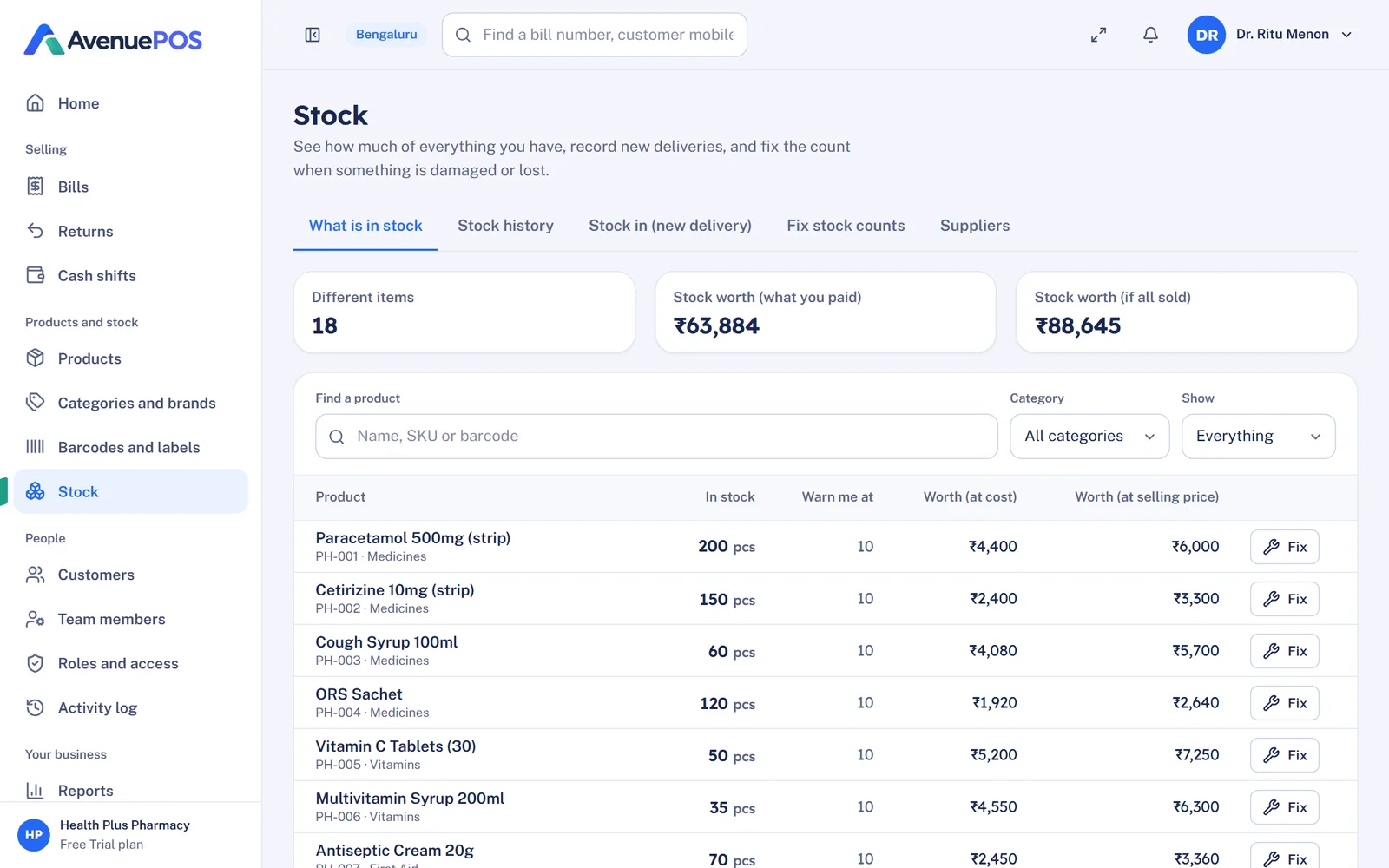
Without a system, stock is a feeling in the owner's head. Then the day comes when a fast-selling item is out, and a slow-selling item has been sitting for six months. Live stock from a POS system turns the feeling into a number you can check, and warns you before you run out.
5. Quick-commerce and online sellers have set new expectations
Customers compare your shop with an app that shows exact prices, takes any payment and sends a bill. You do not need to match an app. But if your counter is slower and less accurate, people notice. A POS system helps a local shop compete where it is strongest: personal service, backed by speed and accuracy.
6. You stop being the only person who knows the shop
When the owner is the only one who knows the prices, the credit given to regular customers and what is in the godown, he can never take a day off. With a system, the knowledge lives in the software, and a trusted manager can run the counter. A wedding, a festival trip or illness no longer means closing the shop.
7. Records help when you need a loan or a better deal
Banks and suppliers like to see clear sales records. A POS system gives you month-wise sales, tax reports and profit figures in a form you can share. Clear records also help your chartered accountant, and often reduce the time he needs, and the fees he charges.
8. Returns and exchanges stop being arguments
When a customer returns an item, the system finds the original bill, shows the price paid and the date, and handles the refund, exchange or store credit. The original bill is never changed. It saves your time, and it keeps the relationship pleasant.
9. Growth does not multiply confusion
A second counter, a second branch or a new line of products can double the paperwork. In a POS system, you add the counter, and stock and reports follow. Each manager sees only their own branch, and you see all.
10 signs that your shop is already late
- There is a queue at the counter during peak hours, and some people walk out.
- You or a family member must stay at the counter all day.
- The cash in the drawer rarely matches the book.
- The UPI total on your phone does not match your register.
- You find out an item is out of stock only when a customer asks.
- You do not know which items give you the most profit.
- A helper can change a price or give a discount without anyone knowing.
- GST month means a pile of bills and a stressed accountant.
- You have lost a bill book, or a page, at least once.
- You cannot tell how the shop did today until you count everything at night.
If you ticked three or more, it is worth a trial. If you ticked six or more, you are probably losing money every week without knowing it.
What does staying manual really cost?
Here is a simple way to estimate it. These are illustrative numbers, so replace them with your own.
| Leak | Example per month |
|---|---|
| Small billing mistakes: 3 a day × ₹20 × 30 days | ₹1,800 |
| Unrecorded discounts: ₹100 a day × 30 days | ₹3,000 |
| A fast-selling item out of stock for 2 days: lost margin | ₹2,000 |
| Owner's time: 1 hour a day on counting and checking | 30 hours |
| Money leaks, per month | about ₹6,800 |
Compare that with ₹499 a month for a starter plan. Your numbers may be smaller, or bigger, but it is worth doing this sum honestly once. We go deeper into this in Manual Billing vs POS Software: Cost, Speed and Accuracy, and you can see what a POS system costs in How Much Does POS Software Cost in India?
What shops like yours say
Pharmacies and medical stores are among the busiest counters in any town. Medbe Pharmacy in Kochi told us, "Quick billing is important in our business. Avenue POS offers a convenient way to manage customer transactions and daily sales. Overall, we are happy with the experience." And Kundanoor Medical Stores, also in Kochi, said that the billing process is convenient and that maintaining sales details is much more organised. You can read how we handle the special needs of medicines on our page for POS software for pharmacies.
"But my customers are used to my old way"
This is a fair worry, especially in a shop where the owner knows every customer. The truth is, customers do not care how you make the bill. They care that it is quick, correct and fair. And a regular customer who sees a neat printed bill, or receives it on WhatsApp, will often think better of your shop, not worse. You can also keep your personal touch: a POS system can store a customer's name, so that you greet him properly.
How to make the change without trouble
- Start with a free trial and your 50 fastest-moving items.
- Run the new system alongside the old register for a week.
- Train one helper first, and let him train the others.
- Switch fully when the numbers match.
We have a step-by-step plan in How to Implement POS Software in an Existing Retail Store.
The bottom line
A POS billing system is not a luxury, and it is not only for big stores. It is a basic tool, like a lock on the shop door or a UPI QR at the counter, that protects your money and your time. The question is not whether your shop can manage without it. You have managed so far. The question is what you could do with the hours, the rupees and the peace of mind it gives back.